


Picture a homeowner who spots a dark, fuzzy patch on the bathroom ceiling a week after a slow roof leak. Her first move is to search for a mold test kit. It's a natural instinct, but it may not be the right first step.
So, do you need mold testing? Usually not. When mold is visible or has a musty smell, public health agencies say your money and time are better spent finding the water source, drying the area, and removing the mold. Testing does have a few narrow uses, and this guide covers them, along with what testing costs and when it makes sense to bring in a professional.
Do You Need Mold Testing If You Can See Mold?
No. In most cases, visible mold doesn't need a lab result to confirm it. The U.S. Environmental Protection Agency's mold testing guidance says sampling is unnecessary in most cases when mold growth is visible. Mold sampling means collecting air, surface, or material samples and sending them to a lab. The EPA also points out that no federal limits exist for mold or mold spores, so a sample can't show whether a building meets a federal standard.
Illinois guidance goes the same direction. The Illinois Department of Public Health says that if you can see or smell mold, testing is usually not necessary, because there is likely a moisture source that needs repair. The mold needs to be cleaned up and damaged materials removed.
The practical takeaway is simple. A lab report would only confirm what your eyes or nose already told you, and the cleanup would look the same either way.
Why Test Results Rarely Change the Plan
A test result needs something to be measured against, and for mold there is no agreed-upon "safe" level. That is the core reason health agencies don't push testing.
The Massachusetts Department of Public Health lays out its reasoning in three parts:
- Mold spores drift through indoor and outdoor air all the time, so finding mold doesn't automatically signal a problem.
- No federal or state limits say how much mold is too much, so there is nothing to compare results against.
- There is no reliable way to tell whether a person's symptoms came from mold, since bacteria, airborne particles from damaged materials, and other causes can look similar.
That guidance was written for public buildings, but the logic carries over to homes. The Illinois agency adds that testing can't determine whether health effects will occur and usually doesn't help you decide what cleanup steps to take.
Here is a simple illustration. Imagine two similar homes get the same spore count back from a lab. One family has no symptoms, while a child in the other home has asthma that flares up. The number alone can't tell you which household has a problem, so the sensible move in both is the same: fix the moisture and remove the mold.
When Mold Testing Does Make Sense
Testing earns its cost in a short list of situations, mostly after repairs or when a professional needs data to guide a decision.
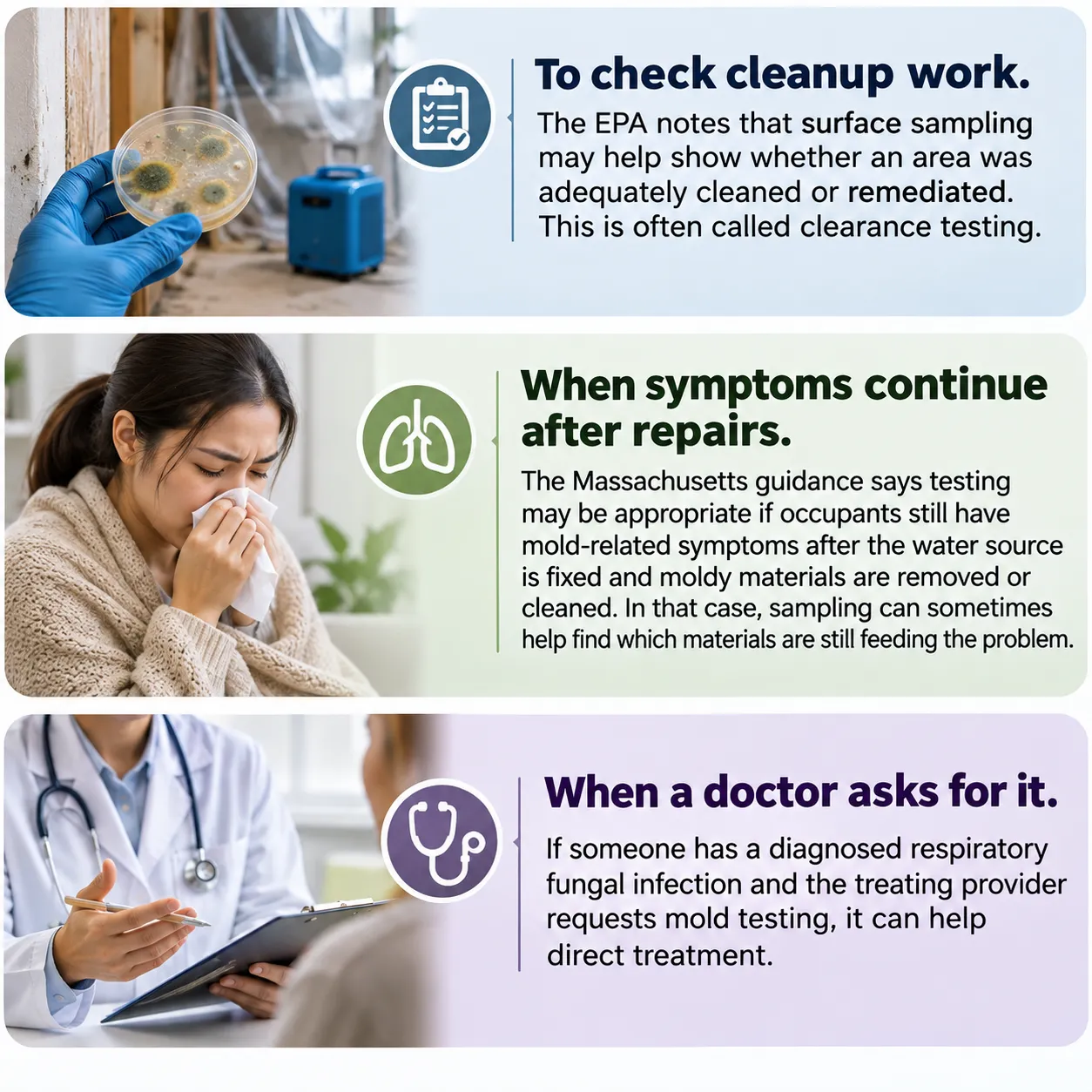
Outside government guidance, testing sometimes comes up in disputes, such as a disagreement with a landlord, an insurance claim, or a home sale where one party wants documentation. Rules and expectations vary, so ask the insurer, agent, or an attorney what evidence they will accept before paying for anything.
Whoever does the sampling matters too. The EPA says it should be done by professionals with specific experience in designing sampling plans, collecting samples, and interpreting results.
What Changes When the Mold Is Hidden
If you suspect mold but can't see it, start by looking for moisture, not by ordering a test. After a leak, flood, or burst pipe, common clues include a musty odor, peeling paint, warped baseboards, stains that keep growing, or a wall that never seems to dry out.
The Massachusetts guidance describes visual evidence and musty odors as reliable indicators of mold problems. A professional can add tools such as moisture meters to find wet materials behind surfaces without tearing everything open. Sampling may come later, but it works best as a follow-up to the moisture investigation, not a replacement for it.
Timing matters here as well. Both Illinois and Massachusetts guidance say wet porous materials, such as drywall and carpet, need to dry within 24 to 48 hours, or mold growth becomes likely. If a leak went unnoticed for days, assume materials behind the surface may need a closer look.
What to Do Instead of Testing
Fix the water problem first, then dry, then remove the mold. The Illinois health department is blunt about the order: any cleanup plan that ignores the underlying moisture will fail.
For small areas, the Illinois guidance suggests these steps:
- Find and repair the source of excess moisture.
- Dry wet areas within 24 to 48 hours, using fans and dehumidifiers where needed.
- Discard heavily damaged porous materials, like carpet and drywall, that can't be thoroughly dried and cleaned.
- Wash hard surfaces with soap or detergent solution, then dry them completely.
- Wear an N95 respirator, gloves, and goggles without ventilation holes, and avoid dry scraping or sanding moldy surfaces, which kicks spores into the air.
The same guidance treats areas under 10 square feet as a reasonable DIY job. Anything larger belongs with a professional remediator.

How Much Does Mold Testing Cost?
Professional inspection with sampling commonly runs from a few hundred dollars to a few thousand. A Clever Real Estate analysis of more than 343,000 inspector quotes, updated in April 2026, put the national average at $687, with a range from $165 to $2,967.
Price depends on home size, the number of samples, and lab fees. The more useful question is what else that money could do. If mold is already visible, the same budget may go further on repairing the leak, renting drying equipment, or replacing damaged drywall.
When to Call a Professional
Call a pro when the problem is larger, hidden, or riskier than a weekend cleanup. These situations usually qualify:
- Mold covers more than 10 square feet.
- The water came from a flood, a sewage backup, or another contaminated source.
- You suspect mold inside walls, under floors, or in the HVAC system.
- Someone in the home has asthma, mold allergies, or a weakened immune system. The Illinois agency notes that mold can trigger asthma attacks, and that people with weak immune systems face a higher risk of infection from certain Aspergillus molds.
- Mold keeps coming back after you clean it.
Choosing who to call takes a little homework. The Illinois health department points to certification programs from groups such as the American Council for Accredited Certification, the IICRC, and NORMI, and it lists the American Industrial Hygiene Association's consultant directory for independent assessments. Some restoration companies handle mold remediation and testing alongside water damage work, which can keep the moisture investigation, containment, and cleanup with one team.
If an insurance or landlord dispute is involved, consider hiring an independent consultant for the assessment. That way, the person writing the report isn't the same one bidding on the cleanup.
A Practical Way to Decide
Start with your senses and your water source. If you can see or smell mold, plan for repair, drying, and cleanup, not a test. If the mold is small and the surface is easy to clean, a careful DIY job may be enough.
Save testing for the narrower cases: checking that a cleanup worked, tracking down a stubborn source after repairs, or meeting a medical or documentation need. When the problem is large, hidden, or tied to a health concern, a qualified professional can sort out the next step with you.


